Bare Metal Cloud Hosting Explained: The Ultimate Guide to Non-Virtualized Infrastructure
What Is Bare Metal Cloud Hosting?
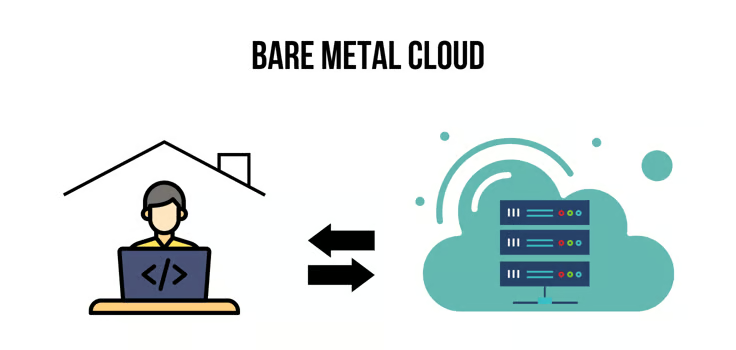
Bare metal cloud hosting is a form of cloud computing that gives you direct access to physical servers without any virtualization layer in between. Unlike traditional cloud hosting where resources are shared across multiple virtual machines, bare metal infrastructure provides you with dedicated physical hardware. Think of it as renting an entire computer exclusively for your needs, rather than sharing space on a communal server with other users.
When you use bare metal cloud hosting, you get complete control over the server’s resources. All the processing power, memory, and storage capacity belong to you alone. This eliminates the overhead that comes with virtualization, making it an incredibly powerful solution for demanding applications and workloads.
Understanding Non-Virtualized Cloud Infrastructure
Non-virtualized cloud infrastructure operates differently from standard cloud hosting. In traditional cloud environments, a hypervisor software layer sits between the operating system and physical hardware, creating virtual machines that share resources. This virtualization adds convenience but also introduces performance overhead.
With non-virtualized infrastructure, you bypass this layer entirely. Your applications run directly on the physical hardware, which means lower latency, faster processing speeds, and more predictable performance. This is especially important when you’re running mission-critical applications that can’t tolerate performance variability or unexpected slowdowns.
Non-virtualized cloud solutions are particularly popular among enterprises handling massive datasets, complex computations, or real-time processing tasks. The absence of virtualization overhead means your applications perform at their peak potential without unnecessary resource consumption.
Bare Metal vs Traditional Dedicated Server: Key Differences
You might wonder what separates bare metal cloud hosting from traditional dedicated servers. While they seem similar, there are important distinctions that matter for your business decision.
Traditional dedicated servers have been around for years. You rent a physical server from a provider, and it’s yours to use exclusively. However, the management and provisioning process is often slower. Setting up a new dedicated server typically takes hours or even days, and scaling up requires manual intervention and downtime.
Bare metal cloud hosting combines the best of both worlds. You get the dedicated physical hardware like traditional servers, but with the cloud’s flexibility and speed. Provisioning a bare metal server takes minutes instead of days. You can scale resources rapidly, and the infrastructure management is streamlined through cloud platforms. Many bare metal providers offer automation tools that make managing multiple servers easier than ever.
Another difference lies in pricing models. Traditional dedicated servers often require long-term contracts and fixed monthly fees. Bare metal cloud hosting frequently offers pay-as-you-go pricing, allowing you to pay only for what you use. This makes budgeting more flexible and cost-effective for variable workloads.
High Performance Computing Server Capabilities
High performance computing servers powered by bare metal infrastructure unlock extraordinary computational capabilities. These systems are built for organizations that need to process enormous amounts of data quickly or run complex simulations and calculations.
Bare metal infrastructure excels at high performance computing because there’s no virtualization layer throttling performance. Whether you’re running scientific simulations, artificial intelligence training models, financial forecasting, or data analytics, you get maximum throughput. The CPU cores operate at full capacity without sharing resources with other virtual machines.
These servers typically feature cutting-edge processors, massive amounts of RAM, and lightning-fast NVMe storage. Some providers offer GPU access on bare metal servers, which is crucial for machine learning workloads and graphics-intensive applications. The combination of powerful hardware and direct hardware access creates an ideal environment for demanding computational tasks.
Organizations using high performance computing often experience dramatic improvements in execution time and job completion. Tasks that might take hours on virtualized infrastructure can complete in minutes on bare metal systems.
When Should You Choose Bare Metal Cloud Hosting?
Bare metal cloud hosting isn’t right for every situation, but it’s ideal for specific use cases. If you’re running applications with unpredictable traffic patterns and need auto-scaling capabilities, virtualized cloud hosting might serve you better. However, if you have predictable, resource-intensive workloads, bare metal is worth considering.
Choose bare metal cloud hosting when you need guaranteed performance with zero noisy neighbor issues. Unlike shared environments, your server’s performance doesn’t degrade when other users on the same physical hardware increase their resource consumption. You also benefit from bare metal when you require specialized hardware configurations, specific software stacks, or need to comply with regulations requiring dedicated infrastructure.
If you’re deploying databases that need consistent, high-speed access to storage, bare metal excels. Similarly, applications requiring low latency for real-time processing benefit tremendously from eliminating virtualization overhead.
The Bottom Line
Bare metal cloud hosting represents a powerful middle ground between traditional dedicated servers and cloud flexibility. By combining dedicated physical hardware with cloud provisioning speed and ease of management, bare metal infrastructure offers compelling advantages for performance-critical applications.
Whether you’re managing high performance computing workloads, running memory-intensive databases, or deploying applications that can’t tolerate performance variability, bare metal cloud hosting delivers the resources you need. Understanding how it differs from traditional dedicated servers and virtualized alternatives helps you make informed decisions about your infrastructure strategy. For organizations demanding maximum performance and control, bare metal cloud hosting is increasingly becoming the go-to solution.
Choosing the right infrastructure setup is essential for maintaining control and maximizing your technical stack. If you found this breakdown helpful, explore these resources to further optimize your server ecosystem:
Internal Link: https://congresodewebmasters.com/best-free-web-hosting-control-panels-cyberpanel-plesk/
External Link: https://congresodewebmasters.com/bare-metal-cloud-hosting-explained/
Leave a Reply