E-commerce enterprises are confronted with an unprecedented challenge in the current hyper-competitive digital marketplace: distinguishing themselves from the millions of competitors that are competing for the same customer attention.
What is the solution? Programmatic SEO for E-commerce—a data-driven, scalable approach to optimization that transforms how online retailers rank, attract, and convert customers.
Traditional SEO has always been labor-intensive, requiring manual optimization of individual pages and keywords. But programmatic SEO for e-commerce changes this equation entirely. Forward-thinking e-commerce businesses are achieving exponential growth by automating content creation, technical optimization, and page generation at scale, while their competitors are squandering resources on antiquated manual methods.
This all-inclusive manual delves into the implementation of programmatic SEO strategies that significantly impact your e-commerce business.
What is programmatic search engine optimization (SEO) for e-commerce?
Programmatic SEO for e-commerce refers to the automated generation and optimization of pages, content, and technical elements based on data patterns, user intent, and algorithmic frameworks. Unlike traditional SEO, which focuses on optimizing existing pages, programmatic SEO creates hundreds or thousands of optimized pages dynamically—each targeting specific keyword variations, product combinations, or user segments.
This implies the following for e-commerce retailers:
– Dynamic page generation based on product attributes, filters, and user behavior – Automated content creation tailored to search intent and seasonal trends – Technical optimization at scale across entire product catalogs – Intelligent internal linking strategies that enhance crawlability and distribute authority – Personalized experiences that drive both rankings and conversions
Consider a furniture retailer with 500 primary products. Instead of manually optimizing 500 pages, programmatic SEO automatically generates thousands of variations (e.g., “affordable leather couches in Los Angeles,” “modern sectional sofas under $1000,” “sustainable recliners for small spaces”). Each page is strategically linked internally, optimized for technical efficiency, and optimized to meet specific search demands.
The Importance of Programmatic SEO in the Development of E-Commerce
The numbers speak for themselves. Report on the implementation of programmatic SEO by e-commerce sites:
– 300-500% increases in organic traffic within 12 months – 40-60% improvement in organic conversion rates – Significant reductions in customer acquisition costs through organic channels – Better market penetration in long-tail and geographic niches
The reason is simple: most search volume lives in the long tail. According to recent data from Moz, approximately 15% of searches are completely new queries. This means traditional SEO targeting high-volume head keywords misses 85% of potential opportunities. Programmatic SEO captures this long-tail volume systematically.
Additionally, Google’s recent algorithm updates emphasize user experience and content quality. Programmatic SEO, when implemented correctly, actually improves both by:
– Producing content that precisely aligns with user intent at various stages of the purchase funnel – Guaranteeing the uniformity of technical optimization across thousands of pages – Improving internal link architecture and page discoverability – Personalizing experiences based on user behavior and location data
Best Solutions for SEO for E-commerce: Core Strategy Components
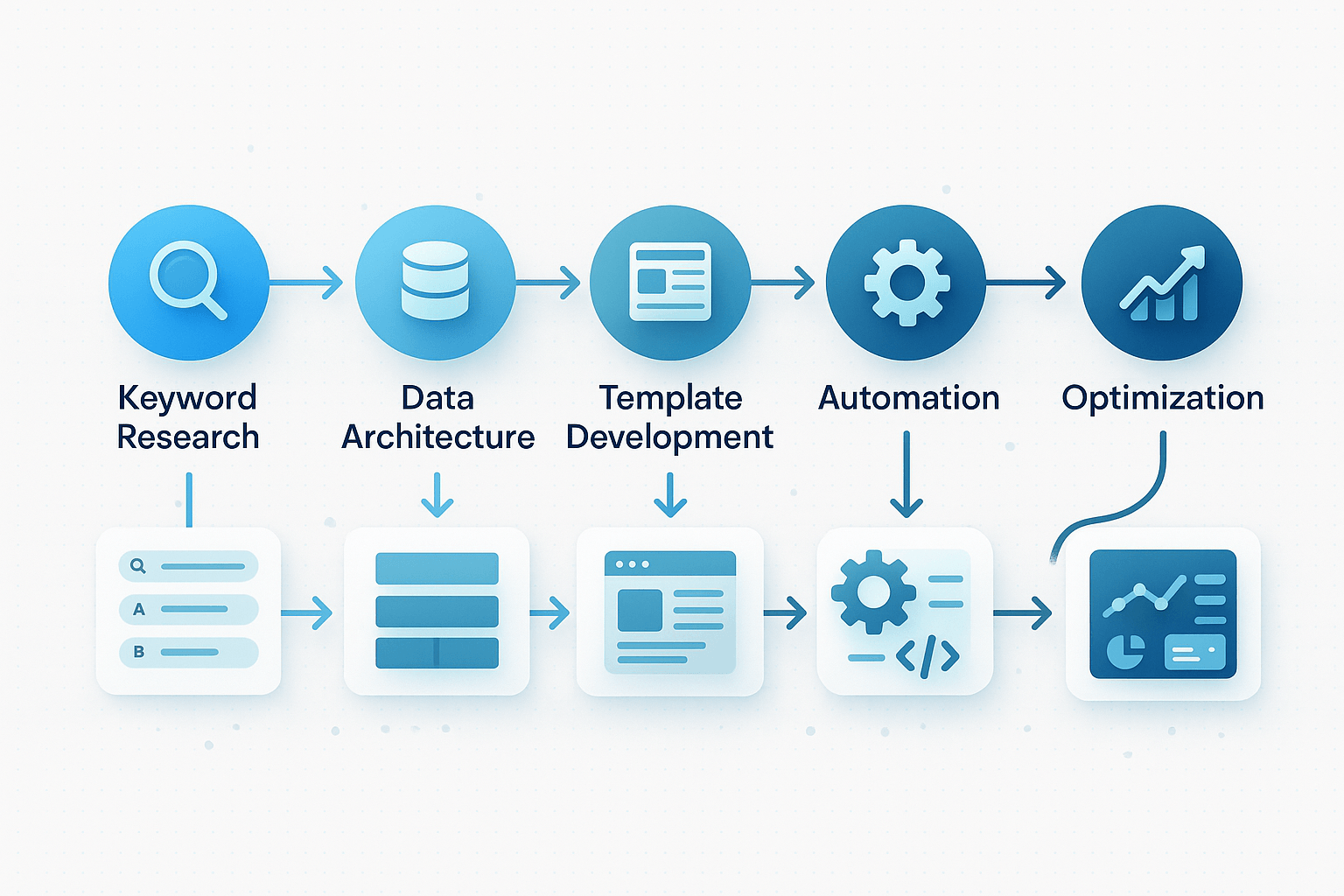
1. Data-Driven Keyword Clustering and Intent Mapping
The foundation of effective programmatic SEO for e-commerce is understanding search intent at scale. This means:
– Analyzing your product taxonomy against actual search queries – Clustering keywords by intent (informational, navigational, transactional) – Mapping keywords to product combinations and category pages – Identifying seasonal and trending variations in search behavior
Tools like Ahrefs, SEMrush, and Moz reveal untapped keyword opportunities. Your goal is identifying thousands of long-tail variations your current pages don’t address—these become your programmatic content targets.
2. Template-Based Content Architecture
The best tools for SEO for e-commerce leverage sophisticated templating systems. For programmatic SEO, you need:
– Unique, valuable content designs that don’t feel auto-generated – Dynamic sections pulling product data, reviews, and specifications – Natural language variation preventing duplicate content issues – Intent-aligned structures matching the customer journey stage
A high-performing product comparison page, for example, might include: – SEO-optimized introduction addressing the specific comparison query – Dynamic product comparison tables populated from your database – User-generated reviews and ratings – Related products section with internal links – FAQ sections addressing common questions for that specific comparison
3. Technical Excellence at Scale
Programmatic SEO for e-commerce requires bulletproof technical foundations:
– Proper canonicalization strategies for similar/duplicate content – Smart pagination and faceted navigation that doesn’t create indexation issues – Structured data implementation (schema markup) across all generated pages – Mobile optimization for every page variant – Core Web Vitals optimization crucial for ranking stability
Google’s recent Core Web Vitals update emphasizes page speed and user experience. It is imperative that programmatic implementations guarantee that each page produced adheres to these standards. This often means:
– Lazy loading for images and content – Efficient database queries for dynamic content – CDN optimization for global delivery – Image compression and format optimization (WebP support)
4. Infrastructure for Strategic Internal Linking
One advantage of programmatic SEO for e-commerce is systematic internal linking. Rather than guessing which pages should link to each other, data-driven approaches:
– Link based on keyword relevance and topical authority – Distribute link equity strategically to priority pages – Create topic clusters that establish topical authority – Implement breadcrumb navigation that helps both crawlers and users
The best strategy involves mapping your product ecosystem and creating logical link pathways that make sense for both users and search engines.
Best Tools for SEO for E-commerce Implementation
Modern e-commerce platforms and SEO tools enable programmatic optimization:
Content Generation & Templating: – Surfer SEO for content optimization templates – Copy.ai and Jasper for scalable content creation – Built-in platform tools (Shopify’s Liquid templates, WooCommerce hooks)
Technical SEO: – Screaming Frog for the purpose of crawling and identifying technical issues – Google Search Console for the purpose of monitoring indexation – Lighthouse for the purpose of monitoring Core Web Vitals
Data Analysis: – Google Analytics 4 for behavior analysis – Ahrefs for competitive analysis and keyword research – Semrush for trend identification and forecasting
Platform Solutions: – Conductor for enterprise programmatic SEO – ContentStudio for scaled content management – Zapier for workflow automation
Implementation Best Practices
Start with Quick Wins: Focus on category pages, filter combinations, and geographic variations first. These typically require less content customization while generating significant organic traffic.
Monitor Quality Carefully: Google penalizes poor-quality auto-generated content. Every programmatic page must provide genuine value. Include user-generated content, real reviews, and product-specific insights that justify the page’s existence.
Build Gradually: Roll out programmatic pages systematically rather than launching thousands simultaneously. Monitor rankings, traffic, and conversion metrics closely, adjusting templates as needed.
Preserve Brand Voice: Automated content does not necessarily equate to soulless content. Inject personality and brand voice into your templates, ensuring visitors enjoy the experience.
Evaluation of Success
Track these metrics religiously:
– Increased organic traffic by page type and template – Enhanced keyword ranking for target phrases – Increased conversion rates by page variant and user segment – Improved crawl efficiency and indexation rates – Core Web Vitals performance and overall page scores
The Future of E-commerce SEO
As AI and automation become more sophisticated, programmatic SEO for e-commerce will become table stakes rather than competitive advantage. The question isn’t whether to implement these strategies—it’s how quickly you can do it effectively.
The businesses capturing growth today are those embracing programmatic approaches while maintaining authentic, user-first optimization principles. The combination of automation and genuine value creation is the formula for sustained organic growth in competitive e-commerce markets.
Leave a Reply